IFRS VBox
Software for automated Valuation, Accounting, Credit Risk and Financial Reporting.
Accurate and standard compliant with IFRS 9, IFRS 16, IFRS 17.
High performance for large portfolios of more than 10 Million accounts.
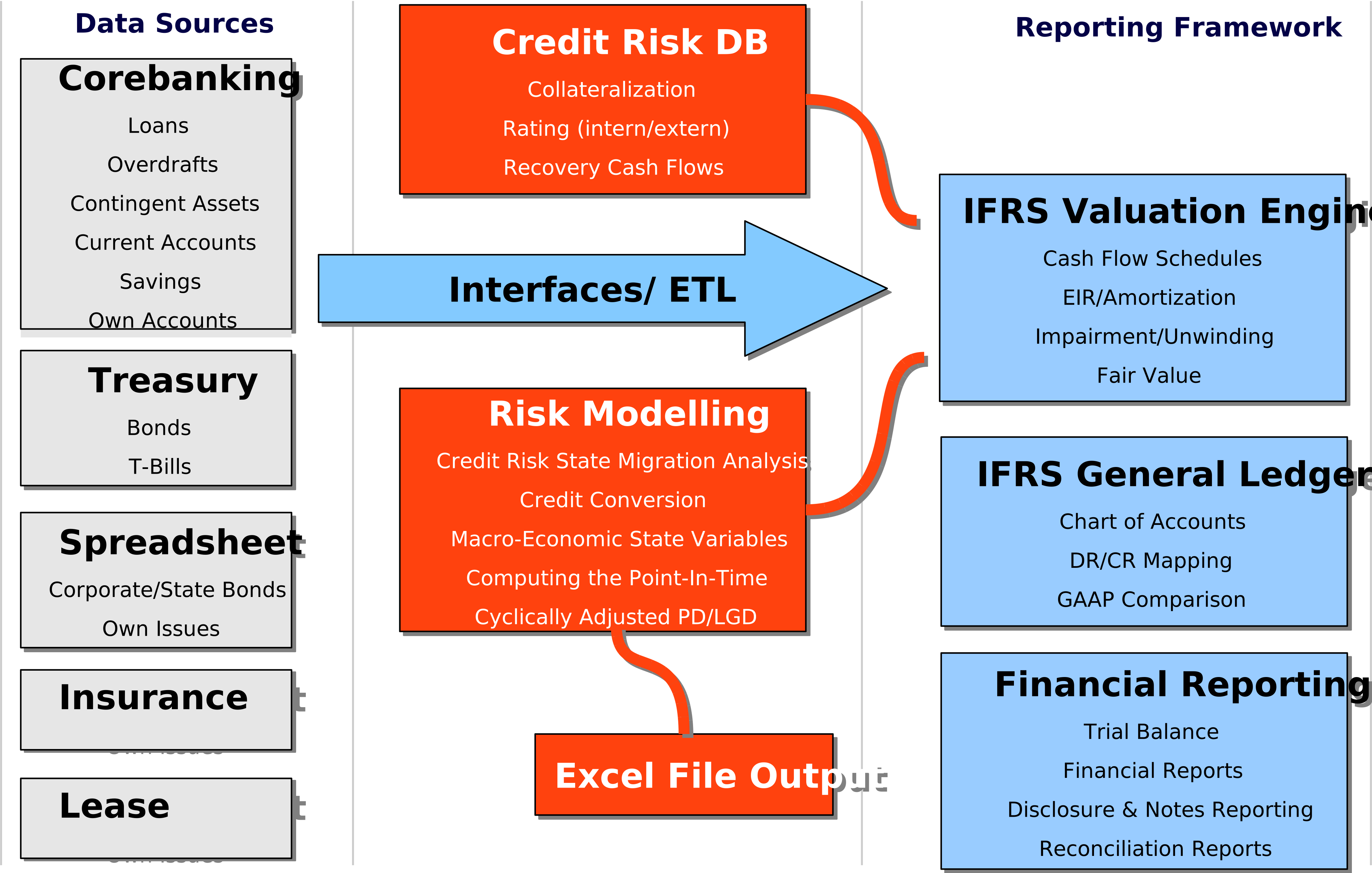
IFRS 9 Solution Architecture
Import of Financial and Non-Financial Instruments
From the Core-banking Systems and Data Sources, Manticore ETL-VBox will import:
Instrument Properties (Type, Origination Date, Maturity Date, Currency)
IFRS Category and SPPI Test
Credit Risk Parameters (Life Time PD Curve, Recovery Assumption, Impairment Stage)
Disbursement
Repayment Schedule
Interest Accrual and Interest Payment Schedule
Attributable Fees and Charges
Purchase or Sale Transactions (incl. Premiums or Discounts)
Market Prices and Yield Curves
Reporting Dimensions, Attributes and Properties (e.g. Cost and Profit Centre)
ETL-VBox can read data from any Database, Spreadsheet, CSV- or Flat-File, JSON- or XML-File or Website.
Cash Flow Schedules
Using the integrated Cash Flow Engine, IFRS-VBox will roll-out comprehensive Cash Flow Schedules:
Contract vs. Settlement vs. Economic Expectation
International Holiday Calendars and Business Day Conventions
Various Disbursement and Repayment Conventions
Various Interest Accrual and Payment Methods
Complex Interest Rate Fixing Agreements (linked to Market Rates, FX-Rates, Indices, Commodity Prices etc.)
Contract:
257258
 Value date  Settl date   n     Rate   T          Amount Cur      Commitment       Principal       Start         End
----------- ----------- --- -------- --- --------------- --- --------------- --------------- ----------- -----------
 2022-06-27               0  7.50000
 2022-06-27  2022-06-27                D    -20000000.00 USD     20000000.00    -20000000.00  2022-06-27  2022-09-26
 2022-09-26  2022-09-26                I       373972.60 USD     20000000.00    -20000000.00  2022-06-27  2022-09-26
 2022-09-26              91  7.50000
 2022-09-26  2022-09-26                R     20000000.00 USD     20000000.00            0.00  2022-09-26  2022-09-26
----------- ----------- --- -------- --- --------------- --- --------------- --------------- ----------- -----------

Settlement:
257258
 Value date  Settl date   n     Rate   T          Amount Cur      Commitment       Principal       Start         End
----------- ----------- --- -------- --- --------------- --- --------------- --------------- ----------- -----------
 2022-06-27               0  7.50000
 2022-06-27  2022-06-27                D    -20000000.00 USD     20000000.00    -20000000.00  2022-06-27  2022-09-26
 2022-09-26  2022-09-26                I       373972.60 USD     20000000.00    -20000000.00  2022-06-27  2022-09-26
 2022-07-05               8  7.50000
 2022-09-26              83  7.50000
 2022-09-26  2022-09-26                R     20000000.00 USD     20000000.00            0.00  2022-09-26  2022-09-26
----------- ----------- --- -------- --- --------------- --- --------------- --------------- ----------- -----------
 Date                                     Accrued             Principal       Smoothing
 2022-07-05                                    -32876.71        -20000000.00          277.05

 Fee Type    EIR Excl       EIR Incl         PV Excl             PV Incl       Unamortized    Start Date  End Date
                7.43074      7.43074         20032599.66         20032599.66            0.00
----------- ----------- --- -------- --- --------------- --- --------------- --------------- ----------- -----------
 Latest Spread               5.86784      FV 32 M-t-Model       -20032604.15
 Average Spread              5.86784      FV 39 M-t-Model       -20032604.15
Valuation and Measurement
Based on the Contractual Cash Flows, IFRS VBox will calculate the Effective Interest Rate (EIR):
(1)¶\[PV_{i-1} = \sum_{t=i}^n CF_t \cdot e^{ \frac {-y \cdot TG_t} {365}}\]
When the EIR is known, the Amortised Cost can be calculated as Total Present Value of the future Expected Cash Flows (based on the actual settlement).
(2)¶\[PV_i = \sum_{t=i}^n CF_t \cdot e^{ \frac {-y \cdot TG_t} {365}}\]
The EIR will be re-calculated whenever the Contract is changed (e.g. Interest Rate adjustment, Purchase or Disbursement). In case of Unexpected Changes (e.g. Late/Early Payments, Sales) the Amortisation Schedule Changes and the difference will be recognised as a Profit or Loss.
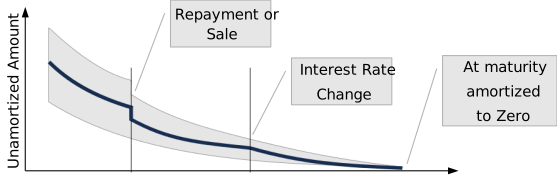
Cash Flow Schedule Events
Financial Instruments subject to Credit Risk will need a Provision according to the Expected Credit Loss (ECL) based on the following Credit Risk Parameters:
Impairment Stage (based on Deterioration of Credit Risk since Origination)
Credit Conversion Factor (CCF) for Contingent Portions
Life Time Probability of Default (PD) Curve Point in Time (PIT)
Collateral
Recovery Expectation
Note
Those Credit Risk Parameters can be modelled in Risk VBox.
Financial Instruments at Fair Value will be measured
either Mark-to-Market based on Quotes in liquid markets
or Mark-to-Model based on Discounted Future Cash Flows — using a Risk Free Yield Curve and the Credit Spread.
(3)¶\[FV_i = \sum_{t=i}^n CF_t \cdot e^{ \frac {-(y_i + CS) \cdot TG_t} {365}}\]
Note
IFRS VBox supports Bootstrapping of Zero Coupon Curves from observed Spot Rates. It also helps to determine the applicable Credit Spreads by comparing the actually Observed Prices against the Risk Free Yield Curves.
During the Valuation, IFRS VBox will calculate more than 250 different Financial Measures for each Instrument. All those measures are written into the Reporting Data-marts, from where they will feed the Accounting- and Reporting Engines.
General Ledger
IFRS VBox includes a comprehensive General Ledger which supports:
Parallel Multi-GAAP
Configurable Charter of Accounts (CoA) as per GAAP
Configurable Accounting Events and Account Mapping Rules as per GAAP
Interactive Drill down, Trace and Reconciliation
Accounting Events: As per single instrument, the software will observe the Financial Measures over time and generate Postings of the Difference, whenever a change occurs.
Account Mapping Rules: For each Accounting Event, the Debit and Credit Lines can be mapped — either statically or dynamically based on the Instrument’s properties (e.g. Currency, Product Codes, Customer Types, Fee Types).
Although completely configurable and subject to customisation, Manticore will provide its customers with IFRS9 Templates from Best Practise.
Financial and Regulatory Reporting
Since all measurement and posting in IFRS VBox is done as per single Instrument or Contract, VBox can filter and aggregate the figures as per Dimension or Reporting Attribute. Thus it can generate any kind of report such as:
Balance Sheet, Income Statement, Cash Flow Statement etc.
Provisioning, Capital Adequacy, Concentration Risk, Mitigation
Disclosure and Notes
Spreadsheet Form Reports (“Excel”), Band/Sub Reports and XML/XBRL
The Report Information is stored in well documented Comprehensive Data Marts from where it can be accessed with the Internal Report Builder or SQL or any Third Party Report Application. Using ETL VBox, those data can also be pushed into Central Data Warehouses.
Reports are pre-built and archived on a daily basis. Alternatively they can be built on demand and with parameters or filters.
IFRS 9 Financial Contracts
Under IFRS 9, financial instruments are classified into three categories: amortized cost, fair value through other comprehensive income (FVOCI), and fair value through profit or loss (FVTPL). The classification of a financial instrument depends on the entity’s business model for managing the instrument and the characteristics of the instrument itself.
Amortized Cost instruments are those that are held for the purpose of collecting the contractual cash flows and are not held for sale. They are measured at amortized cost, which is the amount paid to acquire the instrument, adjusted for any discounts or premiums and any direct costs of issuance.
FVOCI instruments are those that are held for the purpose of collecting the contractual cash flows and for sale in the near term. They are measured at fair value, with changes in fair value recognized in other comprehensive income (OCI).
FVTPL instruments are those that are held for the purpose of selling in the near term or those that are held for trading purposes. They are measured at fair value, with changes in fair value recognized in profit or loss (PL).
IFRS-VBox is compliant with IFRS 9 and can fair-value, post and disclose Financial Contracts such as Loans, Overdrafts, Debt-Securities, Term-Deposits, Borrowings, Swaps, Guarantees and Letters of Credit.
IFRS 16 Lease Agreements
IFRS 16 is a standard issued by the International Accounting Standards Board (IASB) that applies to the accounting of leases. It replaces the previous standard, IAS 17, which was considered to be too complex and lacking in transparency.
The main objective of IFRS 16 is to provide a single, principles-based standard for the accounting of leases that will ensure that lessees and lessors provide relevant and reliable information to their customers, regulators, and other stakeholders. It aims to provide a more transparent and consistent basis for the accounting of leases, and to improve the comparability of the financial statements of entities that enter into leases.
Under IFRS 16, a lease is defined as a contract in which the lessor conveys the right to use an asset to the lessee in exchange for consideration. Leases are classified as either finance leases (which transfer substantially all the risks and rewards of ownership to the lessee) or operating leases (which do not transfer substantially all the risks and rewards of ownership).
Finance leases are required to be recognized as a liability (the “lease liability”) and an asset (the “right-of-use asset”) on the balance sheet of the lessee. The lease liability represents the present value of the future lease payments, while the right-of-use asset represents the lessee’s right to use the underlying asset. The lease liability is reduced and the right-of-use asset is depreciated over the lease term.
Operating leases, on the other hand, are not recognized on the balance sheet of the lessee. Instead, the lease payments are recognized as an expense on the income statement on a straight-line basis over the lease term.
Overall, the implementation of IFRS 16 is intended to provide a more accurate and transparent picture of an entity’s financial position and performance, and to improve the comparability of the financial statements of entities that enter into leases.
IFRS-VBox is compliant with IFRS 16 and can fair-value, post and disclose Lease Agreements.
Example Lease Amortisation
IFRS 17 Insurance Contracts
IFRS 17 replaces the previous standard, IFRS 4, which was considered to be inadequate for the accounting of insurance contracts.
The main objective of IFRS 17 is to provide a single, principles-based standard for the accounting of insurance contracts that will ensure that insurance companies provide relevant and reliable information to their customers, regulators, and other stakeholders. It aims to provide a more transparent and consistent basis for the accounting of insurance contracts, and to improve the comparability of the financial statements of insurance companies.
The fair value of an insurance contract is determined using actuarial techniques, which involve the estimation of future cash flows expected to be received under the contract, taking into account the terms and conditions of the contract and any relevant external factors (such as market conditions and interest rates). The present value of these expected cash flows is known as the “contractual service margin”, and represents the fair value of the insurance contract.
Actuarial techniques are methods used by actuaries to analyze and assess risk and uncertainty in financial, economic, and other contexts. Actuaries use these techniques to calculate the probability and likely cost of future events, such as the occurrence of an insurance claim.
Some common actuarial techniques include:
Probability calculations: Actuaries use probability theory to estimate the likelihood of different events occurring. For example, an actuary might calculate the probability of a person making an insurance claim based on factors such as their age, medical history, and the type of insurance coverage they have.
Statistical analysis: Actuaries use statistical methods to analyze large amounts of data and identify patterns and trends. This can help them to make more accurate predictions about future events.
Financial modeling: Actuaries use financial modeling techniques to estimate the future cash flows that are likely to be received or paid under different scenarios. This can help them to determine the fair value of an insurance contract, or to assess the financial viability of a new product or business venture.
Overall, actuarial techniques are used to assess and manage risk and uncertainty in a variety of contexts, including insurance, finance, and investment.
The fair value of an insurance contract will change over time as the terms and conditions of the contract change, or as the estimates of future cash flows are revised. These changes in the fair value of an insurance contract are required to be recognized in the income statement.
Overall, the fair value measurement of insurance contracts under IFRS 17 is intended to provide a more accurate and transparent picture of an insurance company’s financial position and performance, and to improve the comparability of the financial statements of insurance companies.
IFRS-VBox is compliant with IFRS 17 and can fair-value, post and disclose Insurance Contracts and Re-Insurance Contracts.
Claim Scenarios
Example Life insurance
The contractual service margin (CSM) is the present value of the future cash flows expected to be received under an insurance contract, as required to be recognized under IFRS 17.
In the case of a life insurance contract, the CSM represents the present value of the future premiums, claims, and other cash flows expected to be received or paid under the contract.
To calculate the CSM for a life insurance contract, an actuary would first need to estimate the future cash flows that are expected to be received or paid under the contract. This would involve taking into account factors such as the terms and conditions of the contract, the characteristics of the policyholder (such as their age and health status), and any relevant external factors (such as market conditions and interest rates).
Once the future cash flows have been estimated, the actuary would then need to determine the present value of these cash flows using a suitable discount rate. The present value is calculated by applying the discount rate to each future cash flow, taking into account the time value of money (i.e., the idea that a dollar received in the future is worth less than a dollar received today).
The CSM is then calculated as the sum of the present values of the future cash flows. It is important to note that the CSM will change over time as the estimates of the future cash flows are revised, or as the terms and conditions of the contract change.
Overall, the calculation of the CSM for a life insurance contract involves the use of actuarial techniques to estimate the future cash flows expected to be received or paid under the contract, and to determine their present value.
IFRS S1 / S2 Sustainability and Climate Disclosures
IFRS S1 and IFRS S2, issued by the ISSB in 2023, establish the global baseline for sustainability and climate-related disclosures. Adoption is advancing rapidly: Malaysia is already in its first mandatory reporting year under the NSRF; Nigeria’s FRC mandate takes effect from 2028; Indonesia, the Philippines, Thailand and Vietnam are rolling out ISSB-aligned frameworks for the 2026–2028 cycles.
Nigeria has made considerable progress towards implementation, with more than 50 organisations across different sectors advancing towards full adoption. Unioncrest Capital Limited has directly supported five of these organisations to implement the IFRS Sustainability Disclosure Standards and publish their first reports.
Manticore Projects works with Unioncrest Capital Limited to provide specialist IFRS S1 and IFRS S2 advisory, implementation and training. Unioncrest is led by Grace Fatogbe, an FSA Credential Holder with over 20 years’ experience. She is a member of Nigeria’s Adoption Readiness Working Group for Sustainability Reporting and the IFRS Foundation’s Taxonomy Consultative Group, and a Regulatory Implementation Adviser under the IFRS Foundation’s Regulatory Implementation Programme.
This combination of regulatory involvement and hands-on implementation experience enables Manticore to support organisations from readiness assessment and governance through to data, internal controls, disclosure preparation and assurance readiness.
For a bank or insurer, the computationally material requirement is Scope 3 Category 15 — Financed Emissions: the greenhouse gas emissions attributable to the lending and investment portfolio, disclosed by industry and asset class under the PCAF Global GHG Accounting Standard. The attribution formula itself is straightforward:
(4)¶\[FE = \sum_{i} \frac{Outstanding_i}{EVIC_i} \cdot E_i\]
The complexity lies in resolving the right emission factor for each obligor’s sub-sector, applying the PCAF data quality cascade (DQ 1 verified down to DQ 5 asset-based sector averages), converting Exiobase factors from EUR to local currency with CPI and FX adjustment, and maintaining a full audit trail for limited assurance.
VBox extends its Financial Contracts engine with a PCAF-compliant financed emissions calculator. It consumes the existing VBox loan book — the same exposure-level dataset that drives IFRS 9 ECL and IFRS 7 credit risk disclosures — and produces IFRS S2-compliant disclosures disaggregated by industry and asset class:
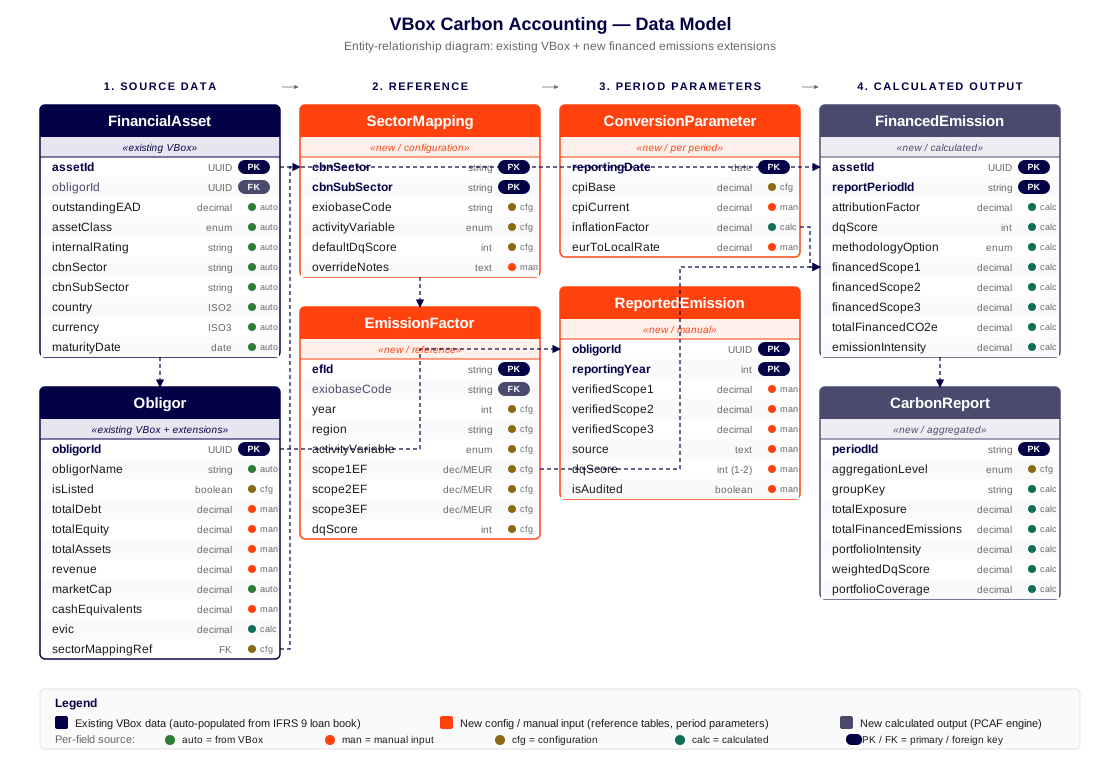
VBox Carbon Accounting — Data Model
Why VBox for S1/S2 Reporting
The data is already in the system. The loan book — exposure, sector, country, rating — is the hardest asset to build, and VBox already has it, reconciled to the general ledger and tested through multiple IFRS 9 audit cycles.
Single source of truth. The same exposures that drive ECL staging feed financed emissions reporting. No reconciliation between parallel systems, no risk that the risk report contradicts the sustainability report.
Multi-jurisdiction by design. Emission factors, sector mappings and CPI/FX parameters are configurable per entity without code changes. One engine runs a consistent methodology across a banking group operating in Nigeria, Indonesia, Malaysia, Thailand and the Philippines, while complying with each local regulator’s format.
Audit-ready and on-premise. Every input, override and calculation step is logged with full data lineage. All processing runs on the institution’s own infrastructure — no borrower data leaves the bank.
IFRS-VBox is aligned with IFRS S1 and IFRS S2 and can measure, post and disclose financed emissions across the full range of PCAF asset classes: listed equity, corporate bonds, business loans, project finance, motor vehicle loans, mortgages, commercial real estate and sovereign debt.